Review: The Kalevala

(“A book that was originally written in a different language” from the Reading Challenge)

The Kalevala is the national epic of Finland. As with many of the older epics, this one is a modern-ish (early-1800s) written collection of stories that were originally an oral tradition, spoken or sung. And, in this particular case, then also a translation from Finnish into English. I’m sure that some of it gets lost in translation, but overall I found it very interesting and I enjoyed it. It took me a long time to actually read all of it (3 years or so), both because it is very long, and because I could read a good chunk of it at a time, but then would need a break before I would feel like reading more. I read it primarily to get some further inspiration for The Wizard of Suomen, not so much in plot or story-line, but more for the feel of ancient Finland as a place, and for some of the descriptions of things and land and animals. I would say that any inspiration for TWoS is more aesthetic than anything else. (The following is more a collection of my impressions than a proper review, so be forewarned. There are also a few slight spoilers.)

The story traces several heroes, and here I will use that term in the older sense as meaning a great warrior or great master of something, rather than the more modern connotation of “a really good person.” The three main heroes whose stories are told are Väinämöinen, Ilmarinen, and Lemminkäinen. (Or at least, those are their usual names. Sometimes the same character was given multiple names or epithets, so it was a little difficult to follow at times. Don’t ask me about pronunciation, I wouldn’t dare try.)

Inasmuch as there is a main character in the Kalevala, it is definitely Väinämöinen, who is an old wizard and musician of great power. He has many adventures, and uses his very-cool-seeming powers to either accomplish great deeds or to get his way. As a modern person, I found him kind of arrogant and annoying at times, but I think that is partially a symptom of my perspective.

Ilmarinen was the only one of the three that I really liked particularly much. He is a blacksmith of great skill, and seemed to get the short end of the stick in many of the stories, but always pushed through and worked hard anyway. My impression was that he was younger than Väinämöinen, but other comments I have seen about the Kalevala seem to indicate that he is an older man too, so I’m not really sure about that.

I really hated Lemminkäinen, who struck me very much as a spoiled, whiny brat who only wanted to get his own way and whose mother very much enabled him. I was pleased to reach the point in the story where he is killed on a quest to the underworld, because by that point I really felt like he deserved it. But then of course he turned out to be the one who got the “my mother will gather my body parts, put me back together, and bring me back to life” story arc, so my relief was short-lived.

The fourth character who gets a large arc, Kullervo, is pretty much just straight-up evil. I think it was prophesized at or before his birth that he would be evil and do lots of horrible things, and he then spent much of his life turning that into a self-fulfilling prophecy, so I liked him even less than Lemminkäinen. Granted, he was also treated very poorly by almost everyone around him, so it’s understandable why he would be angry at everything, but still. (Tolkien apparently found this character fascinating, and his story of Túrin Turambar in The Silmarillion is based on this character Kullervo in the Kalevala.)

There was a lot of interesting repetition and exaggeration, which may or may not have come through the translation well, but fits with what I would expect from an oral tradition. One of my favorites was the description of an ox that was “neither the largest nor the smallest,” but its size was given by stating something like it would take a weasel seven days to run around its head.

The land called Pohjola (possibly the area we know as Lapland today) is always described as “ever-dismal Northland,” which I found very amusing (and again, not surprising!)

The last Rune was the strange story of a young maiden who becomes impregnated by a lingonberry and does this strange virgin-birth thing, which I strongly suspect was added to the tradition after the introduction of Christianity. I often wonder what changes have been made to these traditional stories and epics since the introduction of Christianity into those lands; it would be interesting to know what they were like prior to that time, but of course nothing was recorded in those days, so we will likely never know.

While I didn’t always like the characters, the Kalevala as a whole was an interesting and enjoyable read! I don’t have much to say about the specific stories/adventures, I guess, but they were fun to read. The Wikipedia entry about it seems decent, and I might go through the summary of the story at some point, just to clean up my knowledge of it; there were a few things that I was never quite clear on. There is also interesting discussion there about the man who wrote it down originally and the translations and that sort of thing. I would recommend it to anyone who likes the old epic sagas, who is interested in Finland/Finnish culture, or who is interested in a source that Tolkien drew some of his inspiration from.
Review: The Orc of Many Questions by Shane Michael Murray

(“A book with nonhuman characters” from the Reading Challenge)

I got this book specifically because it seemed like it would have an unorthodox take on orcs, and I was not disappointed.

The story follows a young orc (a “blunc”) who unusually has a fairly sharp mind and a very inquisitive nature; not attributes that are looked on favorably in his tribe. Large, powerful orcs who can be successful in raids against the humans, elves, and dwarves of the world are the ideal, this being the only way that the orcs can procure food, weapons, goods, and “entertainment.” Talking-Wind wants to know why his people are stuck in this life of constant raiding, and even has some hints that life was not always like this for orcs, but he has more questions than answers, and little time to search for them. Talking-Wind’s curiosity draws unwanted attention not only from the other young orcs, who are all too happy to bully someone smaller and weaker, but also from the dragon that demands regular tribute from the orc clan. When the dragon comes for him, Talking-Wind needs all his wits in order to have a hope of surviving long enough to get all of his many questions answered!

This book was a lot grosser than I was expecting, which perhaps should not have surprised me given the subject of the story; there is some gore, but mainly a lot of unpleasant bodily functions! This does not detract from the story, but might be something to be aware of.

It also does a good job with starting to break down the standard fantasy trope of “orcs are evil because they are evil,” which has bothered me more and more in recent years. A certain well-known fantasy series that shall not be named recently doubled-down on this, after spending several books/years looking like they too might be reversing or at least questioning the trope, which annoyed me. Partly for that reason, I’ve been looking for stories that do better and don’t automatically go the route of saying that some races are actually evil by nature. To me, that makes for much less interesting villains/enemies. Easier to kill with a clean conscience, perhaps, but not much else.

There is a sequel which I have not gotten to yet, but do hope to read soon! I would recommend this one to anyone who is interested in a subversion of typical fantasy tropes, anyone who likes a very down-to-earth-complete-with-bodily-fluids type of story, or anyone who happens to be interested in orcs as a fantasy race.

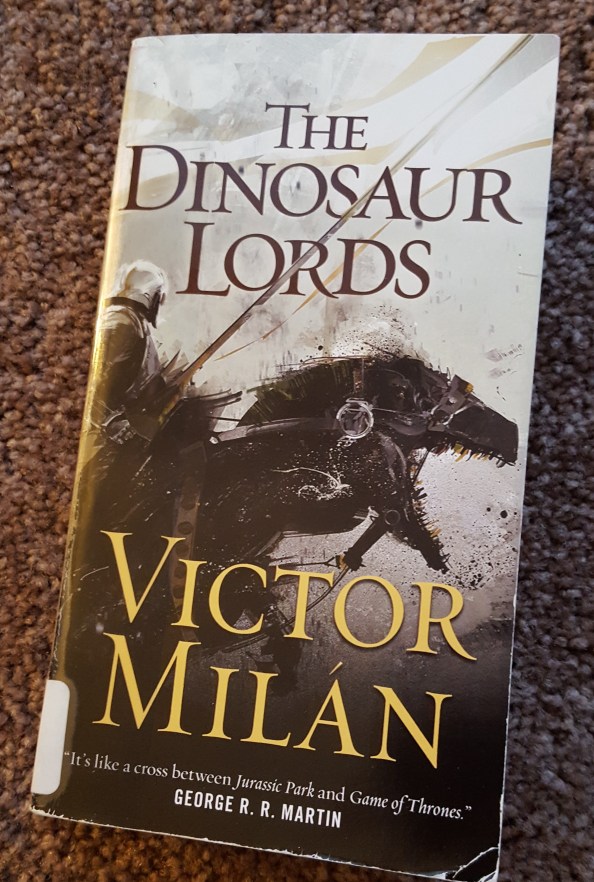
Review: The Dinosaur Lords by Victor Milán

My first thought when I finished this book was “I have died and gone to heaven…or maybe just to Paradise.”

In many ways, this is just another Alternate-Medieval-Europe fantasy (though quite well-written); it has bloody battles, secret (and not so secret) religious fanatics of various flavors, and plenty of political intrigue. I appreciated the author’s way of using languages; the book is written in English, but he uses a blend of English and other languages to give the sense of the different countries, for instance giving titles in both Spanish or French as well as in English. It leaves the reader not needing to guess what unfamiliar words mean, while still getting to see them, learn them, and appreciate the varied vocabulary.

In many ways, it is just another fantasy…but it also has dinosaurs.

Some reviewers have made the point that this story is not a Medieval Jurassic Park. I agree, and would then add that I think it’s much better than that. If you are a Jurassic Park fan and your favorite part is that a bunch of people run around screaming and then get eaten by the dinosaurs, this may not be the book for you (though some people do get killed/eaten by dinosaurs in the story).

I think the best way to describe it is to say that dinosaurs exist in the world of Paradise; they are animals that inhabit the land, and people have learned to exist with them, much as we exist with the many animals around us today. There are some unique challenges to life with dinosaurs, given their often-large size and definite ability to cause harm to humans, but in this world those are challenges that people have undertaken. Some dinosaurs still roam the wild, and are hunted for meat or sport or self-protection by the humans. Many have been tamed or domesticated to one degree or another; they are beasts of burden, war-steeds, pets. The dinosaurs in the world of Paradise feel real, because they are part of the landscape and the ecosystem and the culture; much better than attractions at an amusement park.

To many of the characters, this is all dinosaurs are: part of the landscape, a familiar backdrop to everyday life. But to a couple of the characters (and to the author, I believe), the dinosaurs are more than that: to these characters, dinosaurs are a source of awe. Even as they fully understand and constantly deal with the realities (pleasant and otherwise) of coexisting with dinosaurs, they never lose the lingering edge of breathless wonder at the existence of these great creatures. That, more than anything, was what sold me on this book’s premise and world (and not surprisingly, those two characters are my favorites so far!)

I did enjoy the story itself, and am interested to see where it goes in the next two books of this (I believe) trilogy. This is a very adult book – plenty of gore, sex, violence, and foul language. If you don’t mind those things, then I would recommend it to fans of dinosaurs (the author seems to have done his research fairly well), fans of epic medieval fantasy, and fans of stories with battles and political intrigue.

Update on The Wizard of Suomen

My editor (Facets Fiction Editing) returned her edits and suggestions to me several weeks ago. She was very positive about the story, and her suggestions were very helpful! Draft 5 was my working through these, and although there were no major structural changes to be made, it is definitely a stronger story now. She also did a copyedit for me, and helped me fix a number of small grammatical issues. (I have to improve my use of commas and em-dashes. >.>)

One of my other beta readers has been kind enough to do a final proof-read for me on a paper copy, and I am going to read through the same paper copy myself one last time, because I am feeling paranoid about everything right now. There will be some last minor adjustments to make, but the story is largely done.

So, that means it’s time to look at the next steps.

I am still very interested in self-publishing this story, and have been doing some research about this. I found the book Let’s Get Digital: How To Self-Publish, And Why You Should by David Gaughran very helpful in this regard. Not only does he lay out a clear path of the steps you need to go through to do a good job of self-publishing a book, but he also gives a very interesting overview of the history of the publishing industry, Amazon, and e-books, and how these have affected the publishing landscape over the last decade. (I, at least, found this very interesting, and learned many things that I didn’t know.)

My immediate next steps then are getting cover art (I’m looking at some options for this), and formatting the text as an actual e-book. Gaughran recommended Guido Henkel’s Take pride in your eBook formatting tutorial (free), which was very helpful. I also chose to purchase Henkel’s book, Zen of eBook Formatting, which is an expanded and updated version of the tutorial linked above. I am definitely glad that I bought the full book, but if you are putting together a book with a simple format, then the tutorial would probably be sufficient guidance. There were sections of the book that I skimmed, because they described formatting for things that I don’t need to do for my book, but I am glad to know that I have a resource for those things if I need it. Having read the basics twice now, and knowing that I have the book immediately on hand as a reference, I feel confident that I can do this part of the process myself.

I think those are the big things for now! There will be some other minor steps that I may talk about here as I do them, but for now the final editing, cover art, and formatting are my main concerns.

Other writing projects are still in progress. I have backstories for some of the TWoS characters that I’m planning to publish separately as a sort of prequel, and I have started the draft of my other (bigger) fantasy series. I have done a little bit of planning for the TWoS sequel, but that will be out a little ways yet. And it’s possible that I might even finish a short story or two somewhere along the way here. ^_^;;

I’ll continue to post some updates here as I go along. I will be looking for some people to give Advance Reader Copies to, at some point, and I’ll post about that here as well!

Thanks to everyone who has supported me on this project thus far! I’ve learned a lot and it’s really been a lot of fun bringing this world and these characters to life.

~Ethelinda

Rough drafts

As I’m working on book one of the Epic Fantasy Series, I’m trying out the concept of a really rough draft: leaving out names of places and people if I haven’t figured out what they are yet, writing notes to myself as reminders, and just throwing in mini-outlines at certain points if I don’t quite know what’s going to happen in a particular scene yet. This is a different method for a first draft than I’ve tried before, and it’s quite freeing! Rather than get hung up on the details at this stage, I can let the story flow for now, with the reassurance that I’ll go back later and fill in/fix up the things that I’m passing over at the moment.

It does leave me with some (to me, at least) semi-humorous bits here and there, such as:

“…and targeted at the ears of the horses. [is this even a thing? Are horse ears sensitive? As per that one tumblr post, seems like yes, but should look into this]…”

And:

“-C very emotional about losing drum

-they feed him, get him settled for the night?? What time of day even is it.”

(I think it’s late afternoon, actually, but I’ll work it out for sure later. XD)

~Ethelinda

Draft 4 done!

Drafts three and four of The Wizard of Suomen are finished!

Draft three was a line-edit on paper, because it’s easier for me to catch some mistakes that way. I got that done and the edits transferred back to my electronic copy at 12:31AM on February 7, 2016, with the story at 157,594 words, 329 pages in Word.

I finished the fourth draft two nights ago, at 11:00PM on July 26, 2016. As of now, the story stands at 157,228 words, 328 pages in Word.

And, as of Wednesday, I have sent it to my editor! I will be working with Gina Hilse of Facets Fiction Editing. I won’t be doing any further work on it until I get her feedback. Undoubtedly there is still a lot of room for improvement, but I’m looking forward to putting the best possible version of this story out there as a finished product!

In the meantime, I’m going to do some planning on bigger projects, and hopefully get some other short things written (though given my current pace, I make no specific promises. >.>)

~Ethelinda

im/mortal: Grace

The offering house was old, and disrepair would have been a kind word to describe its current state.

Like everyone in town, Aiolos had always avoided the place. It was the offering house of a dark god, though its name was long since forgotten. It was whispered that it was the same god still worshipped by the yela, but the blood-drinking race hadn’t been present on this world for a long time. Something had changed, something had brought about the downfall of their old tyrannical rule, although they were unfortunately not gone altogether from the universe. Whispers claimed that they had restyled themselves under a new name and were no longer a threat to daylight people.

Rumor aside, there was no direct proof that the yela were any better now than in the past, but they were gone. That was good enough for most people, but few were inclined to worship any gods associated with the yela, even now.

Aiolos knew only a little of that history, and didn’t care in the slightest. The only thing he cared about, looking at the rotting wood set on a crumbling stone foundation, was getting in to accomplish his purpose. Continue reading